Wednesday, March 06 | Post-Acute Care, Thought Leadership


Patient-Driven Groupings Model (PDGM) Readiness: Clinical Coding Challenges
By Lisa Selman-Holman, Vice President, Clinical Services, McBee
Background on PDGM
The Patient-Driven Groupings Model (PDGM) is the most significant change to the home health payment reform in the past two decades. The impact from PDGM is expected to significantly shift service delivery and will change the structure of home health reimbursements. A key component for calculating payment under PDGM will be clinical group assignment and co-morbidity adjustment, thus making ICD-10 coding more important than ever.
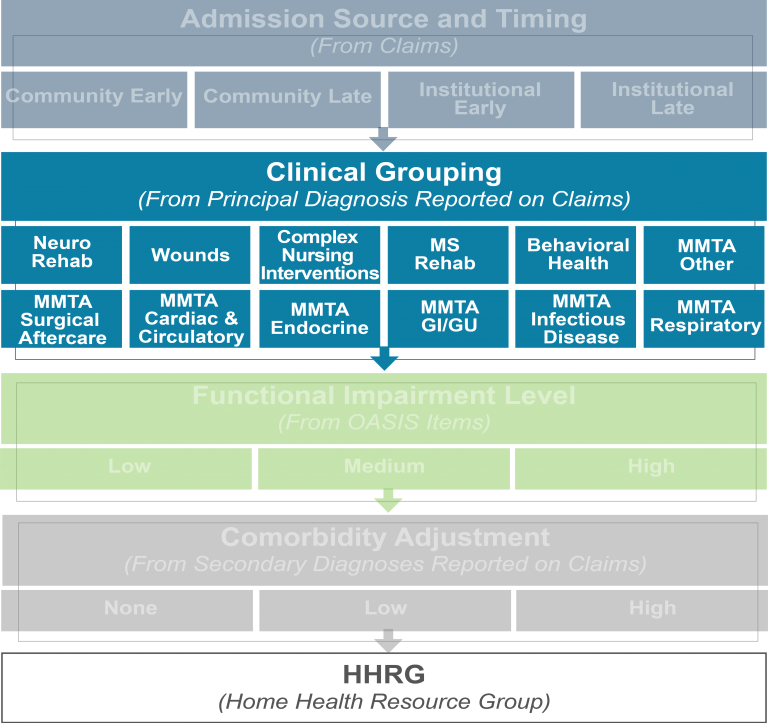
PDGM Clinical Grouping
Based on the primary diagnosis reported on the claim, the patient will be grouped into one of twelve clinical groups. CMS has defined a little over 43,000 ICD-10 codes that will be acceptable for grouping. In contrast, the total number of ICD-10 diagnosis codes is 71,932. This variance produces several diagnoses that will not fall into an acceptable category.
PDGM Clinical Grouping Challenges
It will be a challenge for agencies to ensure all patients can be assigned a clinical group. The list of unacceptable diagnoses includes unspecified and symptom codes that are frequently utilized as primary diagnoses in home care. Under the current payment model, agencies that have patients with these types of diagnoses depend upon chart documentation to fully explain patient acuity and support skilled need. Under PDGM, this practice will not be adequate. Without a clinical group assignment, the case mix cannot be calculated which will result in an inability to submit the claim.
Muscle Weakness (M62.81) is one example that is not included within the acceptable diagnosis list. Agencies should be concerned as this is currently one of the top codes used in home care as a primary diagnosis. It is CMS’s belief that muscle weakness is nonspecific and codes such as muscle wasting and atrophy are more appropriate to depict the need for skilled intervention. Codes that do not specify laterality or location will be another challenge. Physician referral documentation frequently indicate diagnoses such as lung cancer or osteoarthritis. Without further specification of specific lung or joint, these codes are unacceptable also.
PDGM Co-Morbidity Challenges
The need for specific diagnoses is not limited to the primary diagnosis section. PDGM introduces a co-morbidity adjustment that is calculated from up to 24 diagnoses that follow the primary reason home care is tracking the patient. The co-morbidity adjustment can increase reimbursement up to 20%. Therefore, it will be advantageous for agencies to focus on any additional pertinent diagnoses and ensure they are added to the claim.
Specificity and accuracy in ICD-10 will be critical. The long-held practice of accepting whatever patient information physicians deem to send agencies for referrals—because “that’s all they have,” will no longer be an option under PDGM. A close analysis of the referral processes, workflows, clinical assessment and communication with the physician will be required for success within this new payment model. Additional strategic steps that are recommended:
- A comprehensive understanding of ICD-10 coding and associated official guidelines
- Develop a solid foundation of pathophysiology to quickly identify potential underlying etiologies of reported symptoms
- Investigate the underlying cause of symptoms and confirm with physician
- Educate physicians and referral sources regarding requirements for specific diagnosis reporting
- Evaluate current referrals for clinical group assignment and co-morbidity adjustment to discover where changes are needed—specific physicians, referral sources, etc.
- Educate to ensure all clinicians grasp the importance of the changes associated with PDGM
There is a caveat to the above listed actions. Although PDGM is considered budget neutral, CMS theorizes home health agencies will alter their coding and utilization practices to optimize reimbursement under the new payment methodology. This assumption led CMS to build in an adjustment component for payment. The specific amount has not been set; however it is estimated to be a 6.42% cut. This reduction escalates the urgency for agencies to evaluate current practices and develop a transition plan as these cuts will happen regardless of agency actual behavior.
Agencies that take the time to evaluate their current state while looking at the future to tweak and improve will enhance their chances for a smooth and positive transition.
Meet the Author

Lisa
Selman-Holman
· Vice President, Clinical Services, McBee
Communities
Solutions and Services
From the CareThreads Blog
Target Denials Before They Happen: The Role of AI in Revenue Cycle Management
Tuesday, October 20 | Post-Acute Care,Revenue Cycle/Billing,Thought Leadership
Denials have historically been treated as a billing problem. A claim is denied. The billing team investigates. Someone tracks down documentation, contacts a payer, corrects the issue, resubmits the claim and waits. If the claim is denied again, the cycle starts over. But here’s the thing: once a denial reaches billing, the work is no longer about preventing the issue. It is about recovering from it.
Read the blog
A New National Benchmark for Personal Care Is Beginning to Take Shape
Monday, October 19 | Post-Acute Care,Thought Leadership
A potentially important shift in personal care took effect on July 1, 2026. Under the Centers for Medicare & Medicaid Services (CMS) Medicaid Access Rule, states were required to begin publicly reporting standardized fee-for-service payment information for several home- and community-based services, including personal care, home health aide, homemaker and habilitation services. At first glance, this may look like another technical Medicaid reporting requirement. Its longer-term significance could be much greater.
Read the blog
The Hidden Gaps Driving Audit Risk in Post-Acute Care
Wednesday, October 07 | Post-Acute Care,Thought Leadership
Organizations can no longer afford to approach audit readiness as the responsibility of one department. It requires a connected strategy that spans the entire revenue cycle and helps identify risk before it becomes an audit finding.
Read the blog