Tuesday, December 03 | Thought Leadership, Human Services


Drug Diversion Prevention: Compliance Strategies to Mitigate Risk
By Mykel Banks, Director, Acute Services
The opioid crisis and hospital drug theft have been appearing more frequently in headlines for several years, making drug diversion a front-running issue in the acute space. In 2018, the Department of Health and Human Services Office of Inspector General and state and federal law enforcement partners participated in the largest health care fraud takedown in history. According to graph below by the United States Department of Justice, more than 600 defendants were charged with participating in fraud schemes involving about $2 billion in losses to Medicare and Medicaid[1].
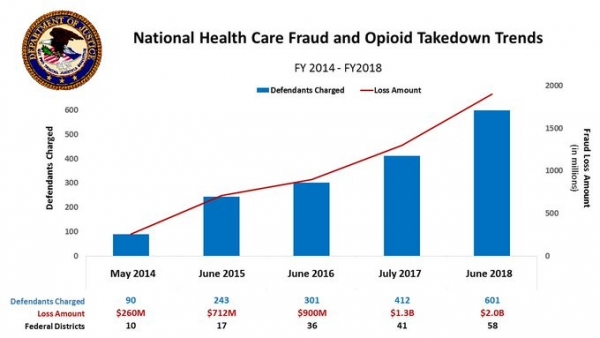
Data shows that drug diversion is an issue that’s very much alive. As a result, hospital drug diversion prevention has been a focus for many compliance departments, with efforts ranging from screening employees, limiting access, and increasing audits and overall security. Drug diversion in the healthcare space can pose major health and safety concerns for patients and care workers alike. Health systems are faced with the challenge of tackling drug diversion to help ensure patient safety and assimilate help for care workers who struggle with addiction. There are steps health systems can implement for a full-lifecycle drug diversion monitoring program that drives diversion out of their facilities and creates a culture of privacy, security, and compliance.
Best Practices for Hospital Drug Diversion Prevention
At a high level, facilities must take a multi-layered approach to a drug diversion prevention strategy. Healthcare privacy, security, and compliance professionals must align to conduct internal audits that search for signs of drug diversion and identify the who, what, when, and how of drug diversion in their facility. Additionally, enhancing hospital policy and procedures and training employees will help drive a culture of compliance that reduces and prevents future incidents.
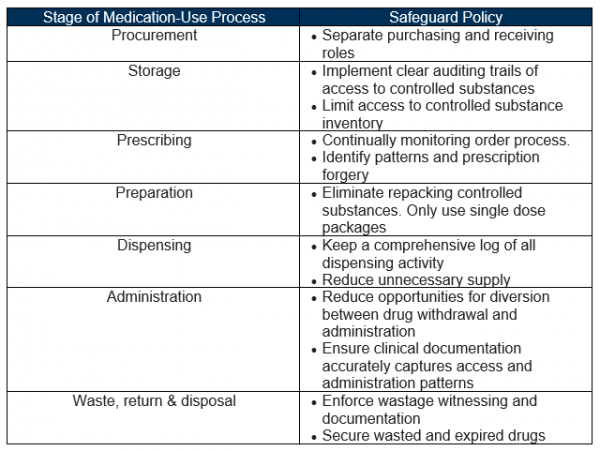
At a more granular level, a facility’s medication-use process (MUP; e.g., procurement, storage, preparation, prescription, dispensing, administration, waste, return, and removal) has multiple vulnerabilities that can be exploited and must be complimented with comprehensive drug diversion policies. The table below outlines the stages of medication-use processes and the safeguard policies they can implement when creating a comprehensive diversion program.
Mitigate Risk through Compliance
The presence of a strong drug diversion program is the most effective method in reducing and preventing drug diversion cases at a hospital. To help prevent drug diversion, it is recommended to have an aggressive audit process in place to help identify drug diversion. It has been found that the simple fact of knowing that you are being monitored on a regular basis increases compliance and minimizes opportunities for diversion. With a solid medication monitoring program supported by a committed drug diversion program, early detection can prevent putting patient safety at risk.
One of the biggest barriers to stopping drug diversion is having proper reporting tools implemented and used at hospitals. Facilities need to have compliance policies and procedures in place to review, track and trend drug dispensing data, validate drug use through patients’ charts, and investigate any variances in data of drug utilization by nurse, condition, physician, patient, etc. Additionally, drug waste disposal procedures should be monitored by the pharmacy and need to be strictly adhered to, immediately reporting any incidents that do not comply.
[1] https://www.justice.gov/opa/documents-and-resources-june-28-2018
Meet the Author

Mykel
Banks
· Director, Acute Services
Communities
Solutions and Services
From the CareThreads Blog
Target Denials Before They Happen: The Role of AI in Revenue Cycle Management
Tuesday, October 20 | Post-Acute Care,Revenue Cycle/Billing,Thought Leadership
Denials have historically been treated as a billing problem. A claim is denied. The billing team investigates. Someone tracks down documentation, contacts a payer, corrects the issue, resubmits the claim and waits. If the claim is denied again, the cycle starts over. But here’s the thing: once a denial reaches billing, the work is no longer about preventing the issue. It is about recovering from it.
Read the blog
A New National Benchmark for Personal Care Is Beginning to Take Shape
Monday, October 19 | Post-Acute Care,Thought Leadership
A potentially important shift in personal care took effect on July 1, 2026. Under the Centers for Medicare & Medicaid Services (CMS) Medicaid Access Rule, states were required to begin publicly reporting standardized fee-for-service payment information for several home- and community-based services, including personal care, home health aide, homemaker and habilitation services. At first glance, this may look like another technical Medicaid reporting requirement. Its longer-term significance could be much greater.
Read the blog
The Hidden Gaps Driving Audit Risk in Post-Acute Care
Wednesday, October 07 | Post-Acute Care,Thought Leadership
Organizations can no longer afford to approach audit readiness as the responsibility of one department. It requires a connected strategy that spans the entire revenue cycle and helps identify risk before it becomes an audit finding.
Read the blog