Monday, February 15 | Interoperability, Legislative/Policy, Human Services


Healthcare Information Blocking Final Rule: A Brief Overview
By AJ Peterson, SVP and GM, CareGuidance
As the COVID-19 pandemic neared the three-month mark, mental health and post-acute providers facing unprecedented challenges serving their communities learned details about new regulations that will significantly impact management of consumer health information. On May 1, 2020, the Office of the National Coordinator for Health Information Technology (ONC) published a Final Rule as required by Congress in the 21st Century Cures Act that sets requirements related to Information Blocking.
Information Blocking is generally defined as a practice likely to interfere with access, exchange or use of electronic health information (EHI), except as covered by an exception or required by law. Information Blocking is all about the data—access to, exchange of, and use of EHI—regardless of what technology is used. The goal of the Final Rule is to give consumers safe, secure access to their EHI. The rule also aims to increase innovation and competition by fostering an ecosystem of new applications to provide consumers with more choices in their healthcare.
The Final Rule defines:
- Who information blocking actors are
- What data elements should be available for interoperability
- Timelines for compliance
- Guidelines on how to identify an Information Blocker
Information Blocking Flow
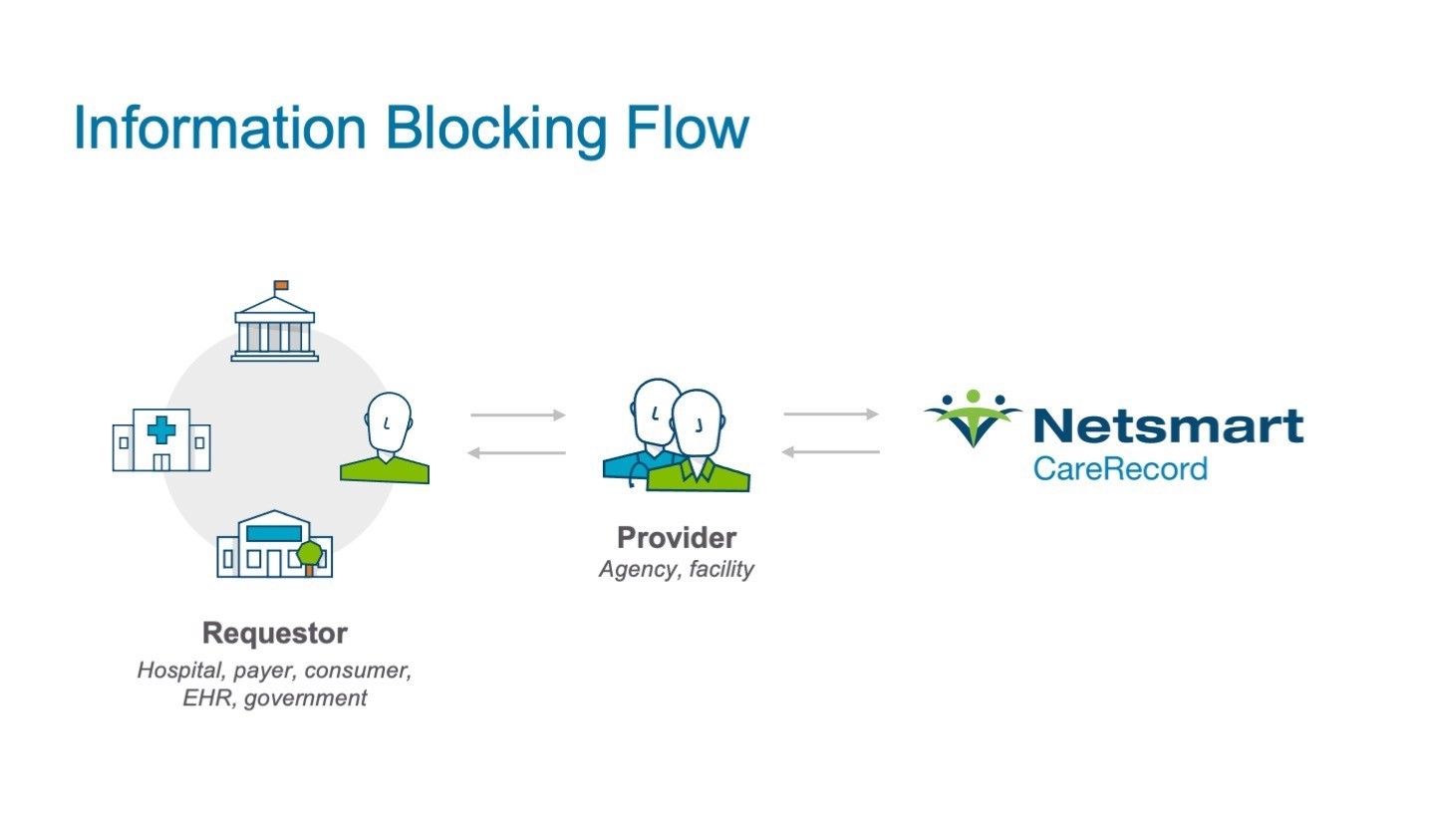
The requestor of the EHI can be the consumer, hospital, agency, government entity, payer, etc. The requestor is responsible for bi-directionally communicating the request to the provider (agency). The provider is responsible for obtaining the requested data and bi-directionally communicating the machine-readable information from the electronic health record (Netsmart CareRecord or other applicable EHR) back to the requestor.
Defining and Sharing EHI
During the first 24 months of the Final Rule, ONC defines EHI as data elements represented in the U.S. Core Data Elements for Interoperability (USCDI). The Information Blocking provisions in the Final Rule apply only to the data that is available in a provider’s system.
Of special interest to behavioral health and mental health providers is the sharing of clinical notes. The Final Rule designates eight types of clinical notes that must be shared:
- Consultation notes
- Discharge summary notes
- History & physical
- Imaging narratives
- Laboratory report narratives
- Pathology report narratives
- Procedure notes
- Progress notes
There are two types of clinical notes to which the Final Rule does not apply:
- Psychotherapy notes. These are notes that can be separated from the other notes that are required to be shared and are recorded (by any medium) by a healthcare provider who is a mental health professional documenting or analyzing the contents of conversation during private, group or family counseling sessions.
- Information complied in reasonable anticipation of or use in a civil, criminal or administrative action or proceeding.
Even with these two exceptions, providers are required to share medication prescription and monitoring information, counseling session start and stop times, modalities and frequencies of treatments provided, results of clinical tests, and diagnosis information.
We also anticipate that providers will require the ability to limit sharing of EHI on a per person basis in cases of consumer privacy or to prevent consumer harm.
Education
The Final Rule is clear that providers can and should educate their consumers about the use of third-party applications and the risks associated with sharing or providing access to EHI. The Rule outlines specific parameters that this education must be consistent, accurate, unbiased and objective. The education should include information about the advantages, disadvantages and associated risk of sharing EHI.
However, education for Information Blocking goes beyond just EHI sharing. Consumers will now be entitled to receive information they might never have seen before. For example, although HIPAA provides consumers a legal right to access the information in their medical records, the Final Rule expands this access to include the immediate electronic availability of notes. Notes contain many clinical/medical abbreviations and verbiage not written with the intent of consumers ever reading the note. Providers need to plan for a true proactive approach to providing consumers with information and education about the care they are receiving, educating clinical staff on writing notes that consumers will read, and updating policies to reflect these new requirements and procedures.
Timetable
In early November 2020, ONC released an Interim Final Rule (IFR) that extended the compliance date for the Information Blocking provisions from November 2, 2020 to April 5, 2021. The purpose of this change was to provide the healthcare community additional flexibility to effectively respond to the COVID-19 public health emergency.
For more information, check out the additional links below
ONC Information Blocking Overview
ONC Information Blocking Exceptions
Questions?
For more information or to learn how your agency can be better prepared for this upcoming rule, please don’t hesitate to contact us.
Meet the Author

AJ
Peterson
· SVP and GM, CareGuidance
Communities
From the CareThreads Blog

The Advantage of Planning Ahead for MIPS 2027
Tuesday, September 29 | Value-based Care,Interoperability
The MIPS 2027 proposed rule offers a glimpse at what providers should expect in 2028 and beyond. Here's what you need to know.
Read the blog
What Providers Still Need to Know About Medi-Cal Payment Reform
Thursday, August 27 | Human Services,California,Thought Leadership
Medi-Cal payment reforms are beginning to take effect. Here are four major takeaways from our recent webinar on the subject.
Read the blog
The Current State of Information Blocking: What Healthcare Providers Need to Know Now
Monday, August 17 | Care Coordination,EHR Solutions and Operations,Interoperability,Post-Acute Care,Human Services,Legislative/Policy,Thought Leadership
Since the enactment of the 21st Century Cures Act, the concept of information blocking has steadily moved from theory to operational reality. Over the past year, federal agencies have signaled a shift from education and guidance toward active enforcement. For healthcare providers, understanding where things stand today is important.
Read the blog