
- Share on:
-
-
-


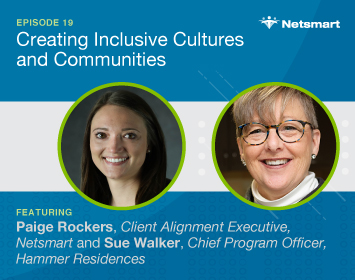
Creating Inclusive Cultures & Communities
Paige Rockers, Client Alignment Executive, Netsmart
Sue Walker, Chief Program Officer, Hammer Residences
Missed Developmental Disabilities Month in March? Don't worry – let’s continue the conversation together.
Individuals with developmental disabilities often face unique barriers that can make it challenging to fully connect to their communities. In order to create a more inclusive environment for all, whether that be regarding employment, social experiences or available resources, open and consistent communication is paramount.
On a recent episode of the CareThreads podcast, Paige Rockers spoke with Sue Walker, Chief Program Officer, Hammer Residences, about the developmental disabilities community and how we can all create a more inclusive world together.
Barriers to Inclusion
Most barriers to inclusion are not as complex as we might imagine. But they're not easy to solve, either. Humans have an innate tendency to seek out people we feel comfortable with and have similar ways of interacting. When people appear, act or respond differently than us, we are inclined to feel uncomfortable or uncertain. This often sparks a gap that affects individuals with developmental disorders, as their interactions, needs and ways of communication are sometimes different.
Individuals with developmental disorders also face challenges with employment. We want to say that people should be employed wherever they want, with whatever their skill is. But in reality, businesses face an array of challenges when it comes to hiring and supporting people with disabilities. There are financial and regulatory issues involved that most folks don't think about.
People with developmental disabilities are highly capable of a wide array of employment opportunities. Employers often need to make adaptations and instill support for people with disabilities in the workplace. It's a space where we have a lot of work to do. And we can all do our part.
We don't always think of everything that people with developmental disabilities might need to feel included. At a business or social event — even in a community, such as accessing a building or a resource — people with developmental disabilities may feel ostracized.
Creating a More Inclusive Community
The more we talk to each other, the more we learn about the barriers other people face. Through honest and genuine conversations, we can work to better understand one another, despite the differing challenges or disabilities.
Communication is the easiest way to overcome barriers for people with developmental disabilities. Hammer's mission emphasizes that we're all people — just humans — and forming relationships is the most important part of the human experience. It's how we get to know, appreciate and support one another.
Whether someone has a disability or not, we need to keep empathy and respect at the forefront of all of our interactions and thinking. It's important to search out all the opportunities we have for communicating with new people in order to grow as a cohesive community that welcomes all walks of life.
While Developmental Disabilities Month of 2021 is in the past, that doesn’t mean the efforts, communication and collaboration should stop. If you’re interested in getting involved or learning more about developmental disabilities a great first step is to volunteer. Simply spending time with individuals helps break down barriers while forming understanding relationships.
The more we participate with one another, without feeling uncomfortable, the more inclusive and accepting we will naturally become.
This discussion with Sue Walker was taken from our show Netsmart CareThreads. If you want to hear more episodes like this one, look for the Netsmart CareThreads podcast on Apple Podcasts, Google Podcasts, Spotify or Stitcher.
You might also enjoy
Lessons Learned Over Four Decades of Fighting for Disability Rights
Kevin Mallot, SVP and Managing Director, Human Services, Netsmart
Robert Stack, President and CEO, Community Options
July 30, 2026
In this episode of the CareThreads Podcast, Robert Stack, President and CEO of Community Options, shares lessons from more than four decades of advancing disability rights and expanding community-based support for people with intellectual and developmental disabilities. He discusses workforce challenges, what motivates caregivers and how AI is helping reduce documentation burdens so providers can focus more on the people they serve.
More
The Outlook for Care at Home in 2026
Maria Warren, VP Post-Acute Strategy and Client Alignment, Netsmart
Dr. Steve Landers, Former President, National Alliance for Care at Home
April 09, 2026
What does the care at home landscape look like in 2026? In this episode, Dr. Steve Landers, former CEO of the National Alliance for Care at Home, shares his thoughts on the forces shaping care at home today and what providers should be preparing for as we move through the year.
More
Voices of Care: From Fragmentation to Fabric
Kevin Scalia, Strategic Advisor, Netsmart
AJ Peterson, Senior Vice President & General Manager, CareGuidance, Netsmart
David Strocchia, Senior Vice President & Managing Director, Provider Solutions, Netsmart
February 10, 2026
Join Netsmart industry experts for a conversation about the history of healthcare digitization in three distinct eras, from paper clipboards through early electronic health records to the modern era of AI and automation. Hear how modernized technology eases administrative burdens for community-based care providers, empowers clinicians to provide confident care and gives individuals greater ownership of their healthcare journey.
More