Monday, December 23 | EHR Solutions and Operations, Value-based Care, Care Coordination, Post-Acute Care


Master Care Coordination: 5-Point Checklist
By Netsmart
Inadequate care coordination frustrates consumers and providers. And it contributes to ineffective and inefficient care.
As post-acute care facilities are being called to be the quarterbacks in a person’s care journey, it’s more important than ever to master care coordination.
Without top-notch care coordination, you’ll struggle to succeed in a value-based, person-centered care world.
We created this five-point checklist to help you discover what you need to successfully coordinate care for the individuals you serve.
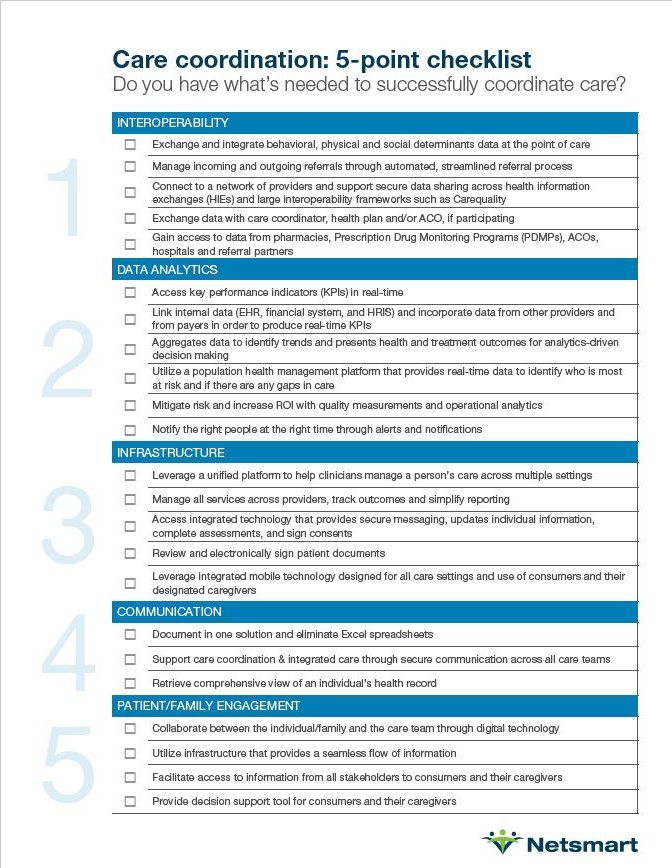
Learn more about how Netsmart can help you improve care coordination in your organization.
Meet the Author

Netsmart
·
Communities
From the CareThreads Blog
Target Denials Before They Happen: The Role of AI in Revenue Cycle Management
Tuesday, October 20 | Post-Acute Care,Revenue Cycle/Billing,Thought Leadership
Denials have historically been treated as a billing problem. A claim is denied. The billing team investigates. Someone tracks down documentation, contacts a payer, corrects the issue, resubmits the claim and waits. If the claim is denied again, the cycle starts over. But here’s the thing: once a denial reaches billing, the work is no longer about preventing the issue. It is about recovering from it.
Read the blog
A New National Benchmark for Personal Care Is Beginning to Take Shape
Monday, October 19 | Post-Acute Care,Thought Leadership
A potentially important shift in personal care took effect on July 1, 2026. Under the Centers for Medicare & Medicaid Services (CMS) Medicaid Access Rule, states were required to begin publicly reporting standardized fee-for-service payment information for several home- and community-based services, including personal care, home health aide, homemaker and habilitation services. At first glance, this may look like another technical Medicaid reporting requirement. Its longer-term significance could be much greater.
Read the blog
The Hidden Gaps Driving Audit Risk in Post-Acute Care
Wednesday, October 07 | Post-Acute Care,Thought Leadership
Organizations can no longer afford to approach audit readiness as the responsibility of one department. It requires a connected strategy that spans the entire revenue cycle and helps identify risk before it becomes an audit finding.
Read the blog